

Five easy reads for getting back into reading
For anyone who needs a little escapism
I used to read a lot. I was never one of those people casually finishing hundreds of books a year, but reading was a regular part of my life. I always had a book with me, I read before bed, and I could spend hours in a bookstore deciding what to pick next. Then grad school happened.
Eventually, I realized how much I missed reading (and no, research articles do not count). I missed the fun of entering someone else’s imagination, appreciating the art of storytelling, and giving my brain a chance to unwind. This feeling ultimately made me want to start making time for reading again.
I also realized that a book does not need to be difficult, extremely serious, or life-changing to be worth reading. Sometimes you just need something that is easy to get into and interesting enough to make you choose it over scrolling on your phone.
So, here are some easy reads for anyone looking to return to reading or make it more of a habit, organized loosely by genre and mood.
If you want to discover a hidden classic: Madonna in a Fur Coat by Sabahattin Ali
Being from Turkey, I wanted to include a novel from home, and Madonna in a Fur Coat felt like the right choice. It is one of the most widely loved classics in Turkish literature, but it is still much less familiar to many international readers.
The novel follows Raif Efendi, a quiet, seemingly ordinary man whose past gradually reveals a love story that shaped the rest of his life. At the center of that story is an unforgettable relationship with Maria Puder, a woman he meets while living in Berlin.
The book draws you in gradually, through conversations, small observations, and the growing sense that there is much more beneath the surface of both characters. It is emotionally rich without becoming overly dramatic, which makes it easy to become absorbed in the story.
I also like that the novel gives its characters room to be contradictory and unsure of what they want. The author does not try to present a perfect romance, but instead explores how difficult it can be to truly know another person.
Sabahattin Ali does this with remarkable simplicity, making the novel very easy to read while still leaving you with plenty to think about afterward.
If you want something reflective and emotional: Never Let Me Go by Kazuo Ishiguro
Never Let Me Go follows Kathy as she looks back on her childhood at a strange English boarding school. At first, everything feels fairly ordinary: friendships, crushes, jealousy, teachers, and small childhood conflicts. Slowly, though, you begin to understand that something is wrong.
While this book is technically science fiction, it does not really read like traditional science fiction. Most of the book is about memory, friendship, love, and how people make sense of lives they did not choose.
I particularly loved the role that memory plays in this book. Kathy does not tell her story in a perfectly organized way. She moves between moments, remembers small details, corrects herself, and occasionally spends a surprising amount of time discussing something that initially seems unimportant. It feels like listening to a real person trying to understand her own past.
The writing is very simple and calm. The author does not force the emotional moments, and the characters often avoid saying exactly what they feel. You understand the tragedy long before they fully acknowledge it themselves.
This was one of those books that stayed in my head long after I finished it.
If you want to feel a little more optimistic: What You Are Looking for Is in the Library by Michiko Aoyama
This book follows several people who feel stuck in different parts of their lives. They each visit a small community library, where a librarian gives them an unexpected book recommendation.
The librarian does not give anyone a perfect answer. Instead, she recommends a book that helps each person notice something about themselves. This is what I loved about this book; it reminded me that feeling stuck does not always require a dramatic reinvention. Sometimes you need a new perspective, a small beginning, or simply permission to imagine that your life could look different. It is warm and hopeful.
Each section focuses on a different person, so the book is easy to read in small pieces. You can finish one character’s story, put the book down for a few days, and come back without forgetting everything that happened. This makes it particularly good for busy periods when your reading schedule is inconsistent.
If you just want to keep turning the pages: The Da Vinci Code by Dan Brown
I know The Da Vinci Code is not exactly a hidden literary discovery. Almost everyone has either read it, watched the movie, or heard someone debate how much of its history should be taken seriously.
I have always loved puzzles and historical mysteries, so this book was very easy for me to get into. The story moves so quickly that there is always another clue to follow or another question waiting to be answered. What I enjoyed most was simply how entertaining it was. The plot does not ask you to slow down and analyze every sentence. It just pulls you into the mystery and makes you want to know what happens next.
The short chapters also make it especially easy to read when you are trying to rebuild the habit. You can tell yourself you will read one more chapter, although that usually turns into several. For anyone trying to get back into reading, I genuinely think a slightly ridiculous conspiracy thriller may be more helpful than choosing a serious classic out of guilt.
If you want a different perspective on the end of the world: Severance by Ling Ma
Severance follows Candace Chen, a young woman living in New York as a strange epidemic slowly empties the city. Even as the world begins to collapse, she continues going to work and holding on to the routines that have structured her life.
I was especially interested in the connection between repetitive labor and the epidemic. The infected endlessly repeat familiar actions from their former lives, but even before becoming infected, many of the characters are already moving through routines they rarely question.
The apocalyptic setting makes the story immediately compelling, but what stayed with me was how the book portrays Candace. She is observant and independent, but also emotionally distant and often strangely passive about her own life. She does not have a clear dream she is chasing or a dramatic plan for her future. I found this feeling of uncertainty very honest. Female characters are often expected to be either inspiringly ambitious or actively rebelling against the lives available to them. Candace is neither.
Severance is sharp, unsettling, and surprisingly easy to get lost in.
Bonus nonfiction pick: All in Her Head by Elizabeth Comen
All in Her Head examines the history of women’s health and the many ways women’s bodies, symptoms, and pain have been misunderstood, minimized, or dismissed by medicine.
What stayed with me most was the reminder that scientific knowledge is not created in a vacuum. It is shaped by the people, assumptions, and institutions behind it. Missing evidence is not always accidental; sometimes, certain questions were simply not considered important enough to ask.
I usually find nonfiction harder to return to when I have been away from reading. This one felt different because it was informative and accessible. But it also made me angry, which I think in this case was part of the point.
It is a good option for someone who wants to learn something while still reading a book with a clear narrative.
Reading for fun can just be fun
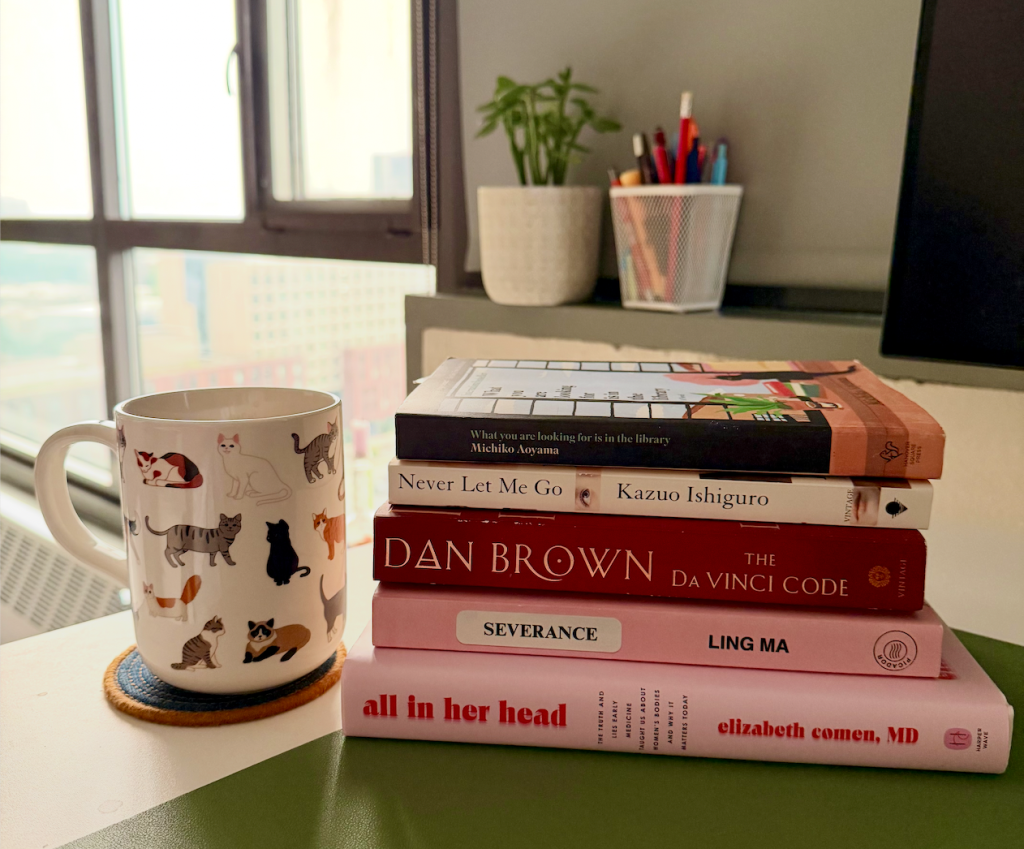
Getting back into reading became much easier once I stopped trying to optimize it and started choosing books that sounded genuinely entertaining. I also gave myself permission to stop reading books I did not enjoy, which is a surprisingly difficult skill to learn!
So, for anyone else with a growing pile of unread books, I recommend starting with something easy, entertaining, and completely unrelated to your research. Your attention span may eventually remember what to do!
Share this post:
