
My First Ironman: Where the Road to a World Record Begins
A story of struggle, endurance, and learning to believe in myself
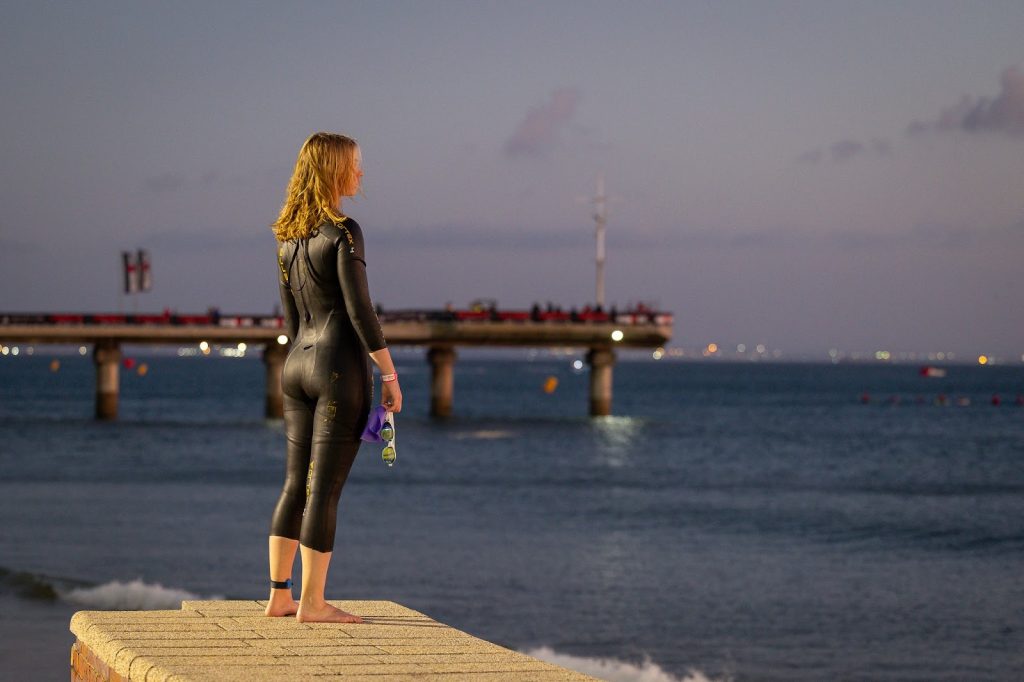
I stood on the beach wall staring out into the ocean as the sun rose, forming the most beautiful purples and pinks. I thought to myself:
“Today, I find out if the work I put in over the last seven months was enough.”
“Today, I find out if the chase towards a world record begins or if I’m left reconsidering my goals.”
“Today, I find out if I become an Ironman.”
This is the story of one of the longest days of my life, a day filled with struggle, pain, joy, and endurance. You don’t need to be training for an Ironman to connect with my experience. If you’ve ever set a goal and felt the weight of the struggle that comes with it, then I invite you to step into this moment with me. My hope is that you’ll find inspiration in what can happen when you chase your dreams and push through the hardest days all the way to the finish line.
Over the past seven months, I went from having almost no endurance background to standing at the starting line of the Ironman African Championships, the first race in my attempt to become the youngest woman to complete an Ironman on all six inhabited continents. For context, an Ironman is no small feat: a 3.8 km (2.4 mile) swim, followed by a 180 km (112 mile) bike ride, and finished with a full marathon (42.2 km/26.2 miles), all in a single day. I set this goal to challenge myself physically and to push the limits of what I believed I was capable of. Along the way, I wrestled with more self-doubt than ever before. But by the time I reached race day, I had already gained grit, tasted triumph, and discovered a passion for enduring.
As the age-group athletes gathered for our pep talk at the start line, I was swallowing back tears. I was proud of the work it took to get here, proud of the leap of faith I took when I signed up for this race. I hoped today would prove that all the hard days were worth it. Deep down, I knew they were, regardless of the outcome, but in that moment, standing on the edge of the unknown, it was hard to fully believe.
The cannon fired for the age-group athletes, and suddenly it was a sprint into the water, a steady stream of as many bodies as could squeeze through the gate at once. The start was chaotic, almost terrifying. At any moment, it felt like I could be shoved under, swallowed not by the Indian Ocean but by the crush of athletes around me. Thankfully, as the swim stretched on, the field began to spread out. The course is an L-shape, and we swam it twice.
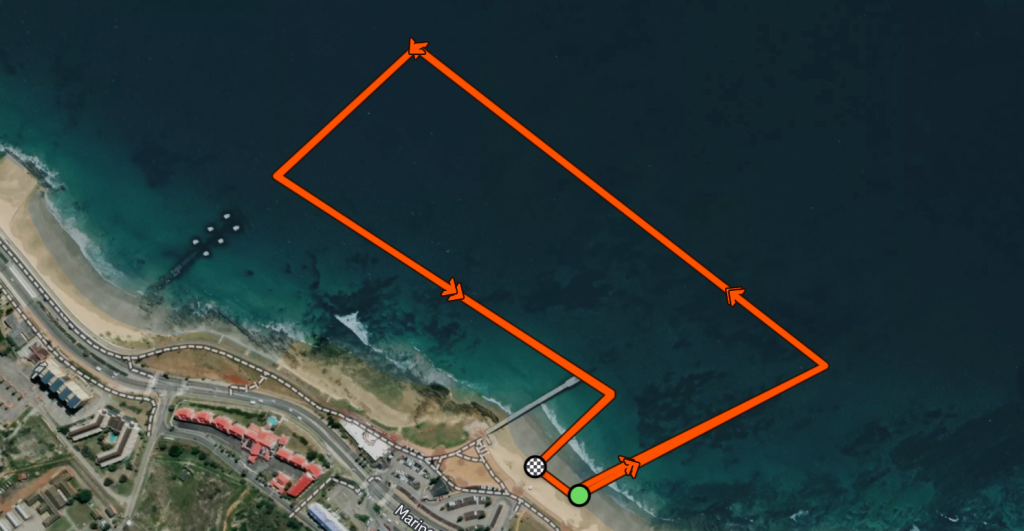
By the time I reached the first turn buoy of the opening lap, the ocean was no longer calm. One-meter swells had picked up, tossing me around and forcing me to time every breath and sight carefully between the waves. What I didn’t realize as I fought across the long side of the course was that the shift from high tide to low had created a rip current slowly pulling me out to sea. Poor sighting and drifting meant I ended up swimming an extra 250 meters just to fight my way back to the second turn buoy. Exhausted, I ran up the beach to start my second lap, and there was my partner Sam, smiling from his spot on the wall and cheering me on. I couldn’t help but smile back, and with that, I felt a surge of energy as I dove in again.
Around this point, I began to feel the chafing from my wetsuit. The Velcro, combined with the sting of saltwater, was grinding into the skin on the back of my neck. Every breath, every movement to sight, came with a sharp sting. I had to block it out and focus, swim harder, hold a better line, and get out of the water as quickly as possible.
But the ocean had other plans. Fighting the rip current and swells had already drained me, and each stroke became a constant negotiation with myself. Part of me longed to switch to an easier stroke, just to catch my breath. At one point, I thought, swimming is supposed to be my strongest discipline. If I was already this tired, how would I possibly handle the bike? I forced myself to shut those doubts down; dwelling on them wouldn’t help me now.
Despite the pain and fatigue, I held my pace and kept a straighter line through the second lap, finally climbing out of the water in 1 hour and 40 minutes. It was 20 minutes slower than I had hoped, but still 40 minutes under the cutoff, a buffer I knew I’d be grateful for once I hit the bike.
I ran up the stairs from the beach and into the transition area. While I stripped off my wetsuit and got into my bike gear, Sam had three important answers to share with me, things we could finally know for certain before the race began:
- How many girls were in my age group? 4 (admittedly not a very important question but my curiosity couldn’t help itself).
Where was the wind coming from? Would I face a headwind first or a tailwind? Headwind (thankfully). - What was my required average speed on the bike to hit the cutoff based on my swim time? 21 km/hr (approx. 13 mph).
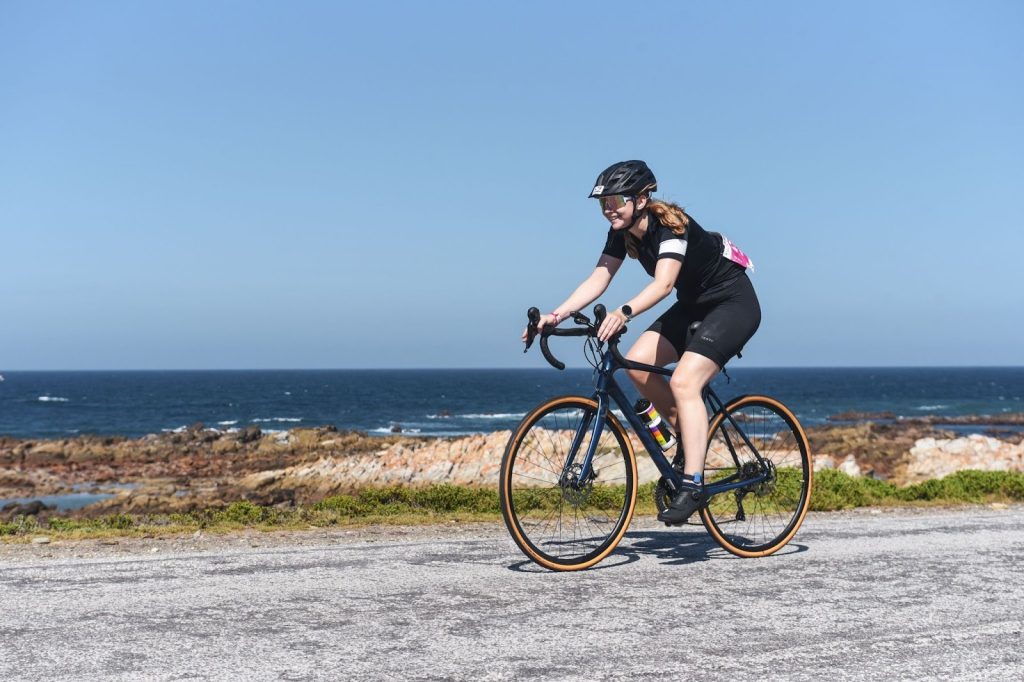
With that bit of encouragement shouted through the fence, I was ready to hop on the bike and tackle the 180 km ride. The course was three laps, each beginning with a long, gradual uphill. As I started the climb, I reached for my water bottle to settle in, only to grab at empty air. I looked down. Gone.
In a split second, I had to decide: turn back and search for it, or push forward to the next water station at the top of the hill. I chose to keep going, hoping I wouldn’t regret it. The bike has always been my weakest discipline, and hills are my worst enemy. This one seemed endless, with only a handful of spectators scattered along the way to cheer us on.
Halfway up, a sharp cramp seized my right side, likely dehydration catching up to me. My position on the bike made it impossible to stretch it out, and soon it began to steal my ability to take deep breaths. Maybe I should have gone back for that bottle. The thought crept in: Is this how my race ends?
I finally crested the hill and sped toward the aid station. The bottles they handed out didn’t fit my cage, so I hopped off, filled a sports bottle, and made sure it was secure. Spectators shouted at me to get back on, and I laughed, calling out that I wasn’t about to lose this one too, a moment of levity that gave me a smile.
The rolling hills that followed offered a break from climbing but left me exposed to a punishing headwind. Despite drinking, the cramp in my side persisted. I fixed my eyes on the turnaround. Once I hit it, the headwind would finally become a tailwind. At kilometer 25, I spotted it, pushed through, then ducked into a bathroom to strip off my sports bra. The dull ache eased slightly, just enough to keep going.
Pushing through the pain, I turned back onto the course with the tailwind now at my back. The change was instant, my mood flipped, and I couldn’t stop smiling. For the first time, the bike felt fun. I even shouted to the riders still grinding against the wind that it was worth it once they turned around. I must have sounded crazy.
The gusts were strong, around 33 km/h (21 mph), double anything I’d trained in, and I knew they’d only build as the day went on. But with the wind and downhills working in my favor, my average speed jumped to 28 km/h (17.5 mph), well above the cutoff pace. That buffer gave me confidence. And with the course now tracing the coast—beaches, dunes, rocky shores, and impossibly blue water—I couldn’t stop smiling at how incredible it all was.
As I rolled back into the city to finish my first lap, I started scanning the crowd for Sam. I wanted him to see me flying by, grinning ear to ear. When I finally caught his eye, the smile on his face said it all. I could feel how proud he was. One-third of the bike was done, and I was still feeling strong.
The next two laps, though, grew tougher. The wind strengthened, the sun bore down, and eating became a battle. My fueling plan—carb drinks, gels, and bars—fell apart when the cramp in my side kept me from chewing the bars. I had to improvise, leaning on gels as much as I could stomach.
My pace dropped each lap until I averaged 24 km/h (15 mph) on the third. But despite the slowdown, I was still happy. I knew I’d make the bike cutoff, and with the hardest part nearly over, I could barely contain my excitement.
After 8 hours and 4 minutes on the bike, I finally hit transition, changed into my running gear, grabbed some gels, and headed out. Sam cheered from the fence, telling me I was in third place for my age group. To my surprise, I felt great—eager, even—to start the marathon.
The twist? I’d never run a marathon before. My plan was to walk a bit every 5 km, but when I hit those marks, I felt too good to stop. I reached the halfway point in 2 hours and 20 minutes, 20 minutes behind my half-marathon PR, and couldn’t help but be thrilled.
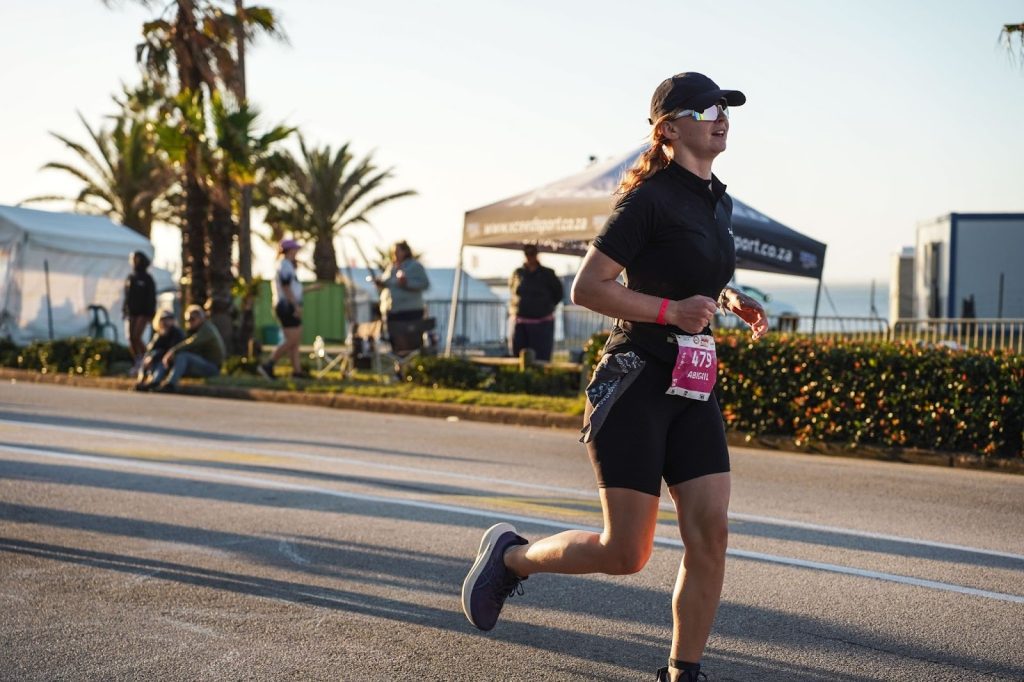
The run was smooth—until, all at once, it wasn’t. My pace collapsed, my lower body seized, and every step became agony. By kilometer 25, I gave in and switched to walking. Later I learned it was glycogen depletion—my muscles had run out of fuel and started breaking themselves down for energy. At the time, all I knew was that running hurt far more than it helped, so walking was my only choice. Still, the slower I went, the further the finish felt.
On lap three, I stopped to talk to Sam, telling him, while holding off tears, how much it hurt just to stand. From where we stood, I could hear the announcer at the finish line declaring, “You are an Ironman.” It felt so close and yet impossibly far, and in that moment all I wanted was for the pain to end.
I put one foot in front of the other, focusing on forward movement—the only way to reach my goal. Hours passed in my own thoughts: Will I finish? Will the pain win? Is this even worth it? The last five kilometers brought relief in the form of two South Africans walking the course. We talked, shared the struggle, and suddenly I wasn’t alone. Misery loves company, apparently.
With just one kilometer to go, my watch buzzed at 3%. There was no way I wasn’t recording my first-ever marathon on Strava. I said goodbye to my new companions and tried to run, or at least something that looked like running. As I reached the turnoff to the finish line, all the pain vanished. Every ounce of focus went to crossing that line. I ran faster, consumed by the sheer joy of completing my goal.
Sixteen hours and four minutes after the race began, I rang the first-time finisher bell and heard the words I had been chasing all day: “Abigail, you are an Ironman.” My smile was unstoppable, and I didn’t even try to hide it. Every ounce of pain, every struggle, every moment of doubt had led to this: pride, accomplishment, and proof that I could endure more than I ever imagined. But crossing the finish line wasn’t the end—it was just the beginning. My world record attempt had officially started, and a new, even greater challenge lay ahead.

The lesson is universal. Your “Ironman” might not involve swimming, biking, or running, but if it’s hard, you will face similar struggles: fatigue, doubt, and moments where you question whether it’s worth it. Just like in my journey, those challenges are what make the victory meaningful. I’ve always liked the quote, “Nothing worth having comes easy, and growth comes when you confront the hard things head-on.” Also, support matters, both in the big moments and the small ones, and it’s out there if you look for it. My support came from friends, teammates, my partner Sam, and all the people on the course. I hope this story inspires you to embrace your own journey and get excited for where it might take you. Personally, I cannot wait for what’s next!
Share this post:
