

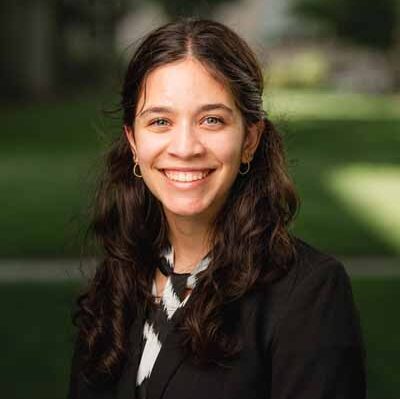
Zeina Rmaile
MIT Department:
Civil and Environmental Engineering
Faculty Mentor:
Gioele Zardini
Research Supervisor:
Meshal Alharbi, Runyu Zhang
Undergraduate Institution:
Georgia Institute of Technology
Biography
Zeina Rmaile is an Aerospace Engineering student at Georgia Tech interested in autonomous multi-agent systems. She has previously designed and built drones in GT’s Lunar Lab, led predictive modeling and automation initiatives at Whisper Aero, and created telemetry visualization tools and command procedures for Europa Clipper at NASA JPL. Through MSRP, advised by Professor Gioele Zardini in the Laboratory for Information and Decision Systems, Zeina’s research expanded a co-design framework for multi-robot systems. Beyond research, Zeina is deeply invested in her community. She advocates for her peers on the School of Aerospace Engineering Student Advisory Council, captains the Colorguard, and serves as a Student Ambassador. She has channeled her passion for STEM inclusion through the Hispanic Organization Promoting Education (HoPe) and the Hispanic Recruitment Team to open doors for the next generation of engineers. Zeina has earned several honors, including the Brooke Owens Fellowship and the President’s Undergraduate Research Award.
Communication-Aware Task-Driven Co-Design of Heterogeneous
Multi-Robot Systems
Zeina Rmaile1, 2, Meshal Alharbi2, Runyu Zhang2, and Gioele Zardini2, 3
1Department of Aerospace Engineering, Georgia Institute of Technology
2Laboratory for Information and Decision Systems, Massachusetts Institute of Technology
3Department of Civil and Environmental Engineering, Massachusetts Institute of Technology
Multi-robot systems attract cross-domain interest due to their distributed capabilities and resilience. Designing an optimal system requires simultaneous optimization across vehicle design, fleet composition, and fleet coordination. To address this, previous work establishes a basic co-design framework that assumes constant inter-robot communication. This work expands that framework, modeling the effects of imperfect communication on design trade-offs for coverage missions by substituting one-shot planning with an iterative replanning mechanism synchronized to intermittent communication windows. Between windows, an error model simulates environmental drift and velocity-dependent trajectory error that accumulates over time. At each communication threshold, the centralized planner takes in each robot’s actual execution history alongside a coverage reward map that favors unexplored regions over redundant paths. The fleet trajectories are then adaptively reconfigured, repeating this process until a user-defined coverage metric is met. Results in a 2D simulation environment highlight the critical trade-offs affected by communication frequency. Less frequent communication intervals increase execution error and redundant coverage. Conversely, high-frequency replanning performs better than the original one-shot plan, but requires significant energy and financial cost. This represents a key step towards modeling system-level trade-offs for heterogeneous multi-robot systems under imperfect communication, laying the groundwork for integrating real-world constraints in multi-robot system co-design.
