
Zakeyah Ross
MIT Department:
Electrical Engineering and Computer Science
Faculty Mentor:
Erik Katsavounidis
Research Supervisor:
Deep Chatterjee
Undergraduate Institution:
North Carolina A&T State University
Biography
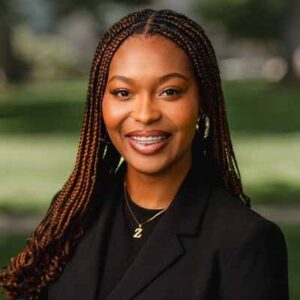
Zakeyah Ross, originally from Los Angeles, California, is a rising 2nd-year Honors Electrical Engineering major at North Carolina Agricultural and Technical State University. She hopes to add Computer Science and Statistics as minors alongside her major. Growing up, Zakeyah took an interest in block coding, which later transitioned to text-based coding through Girls Who Code. The GWC program has been a major part of her identity, and she hopes to continue uplifting young aspiring computer scientists the way GWC did for her. Zakeyah took online courses outside her curriculum to become an intermediate-level Python programmer, progressing from simple programs to training traditional machine-learning classification models and refining her data-cleaning skills. As an MSRP intern, she has gained experience building simple neural networks and evaluating their performance in Python. She hopes to continue developing her programming abilities and applying them to AI/ML research in healthcare, neuroscience, and robotics.
Machine Learning for Gravitational Waves Source Classification
Zakeyah Ross1, Deep Chatterjee2, Erik Katsavounidis2
1Department of Electrical and Computer Engineering, North Carolina Agricultural & Technical State University
2Department of Physics, Massachusetts Institute of Technology
The Laser Interferometer Gravitational Wave Observatory(LIGO) detected gravitational wave (GW) signals for the first time in 2015. Neutron Stars and Black Holes orbit in pairs and merge, which causes disturbances in the spacetime metric in the form of wave-like patterns that get picked up by LIGO and transformed into time-series data. These disturbances –called GW strain– as recorded in LIGO’s time-series data are used to train Neural Network models that detect noise and astrophysical signals that need to be classified. ML models have been developed to classify Binary Black Hole(BBH) and Binary Neutron Star (BNS) mergers. This project focuses on developing a model to detect mergers made up of a Black Hole and a Neutron Star(NSBH). The search pipeline models have unique preprocessing steps for each merger that make training of the models easier. The search pipeline model for BNS uses heterodyning for preprocessing, and the model for BBH uses whitening for preprocessing. To create a prototype model for an NSBH merger, the intended preprocessing step will be a combination of the BBH and BNS preprocessing steps. To execute this, we start with LIGO data, generate simulated waveforms, and inject the simulated waveforms into the data for testing. Then, we modify the search pipeline code (Aframe) and configuration to train the new model that will detect the NSBH mergers that may be present in the LIGO data. Ultimately, we plan to create one search pipeline that can detect GWs from NSBH, BNS, and BBH Mergers in real-time
