

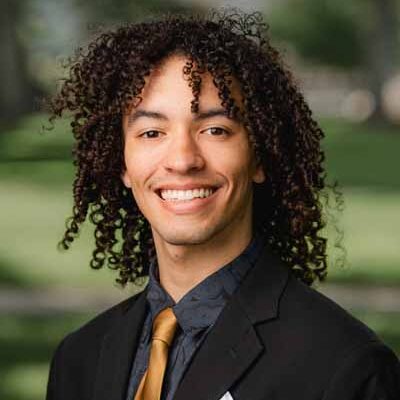
Tobias Classen
MIT Department:
Physics
Faculty Mentor:
Joseph Formaggio
Research Supervisor:
Douglas Pinckney, Mingyu (Charles) Li
Undergraduate Institution:
Wesleyan University
Biography
Tobias Classen is a fourth-year Physics major at Wesleyan University. His interest in the intersection of math and material science was sparked during his time as a TIG welding instructor, and his passion for teaching has remained constant. At Wesleyan, he serves as a teaching assistant for quantum mechanics and hopes to one day teach as a professor. He is also committed to ensuring that his research benefits society, not war. At his home institution, Tobias researches halide segregation in perovskite solar cells, exploring polaron models to explain local inhomogeneities. During his REU at UPenn, he investigated preliminary steps for biodegradable supercapacitors for sensors used to combat agricultural overwatering. Now, at MIT, he simulates cosmic neutron radiation on superconducting quantum devices to combat correlated error. He plans to continue this journey through a PhD in condensed matter physics.
Bogoliubov Quasiparticle Distribution in Superconducting Circuits from
Neutron Impacts
Tobias Classen1, Mingyu Li2, Doug Pinckney2, Joseph Formaggio2
1Department of Physics, Wesleyan University
2Department of Physics, Massachusetts Institute of Technology
Quantum devices are limited in their applicability due to radiation-induced correlated errors. These errors arise from quasiparticles (QPs) forcing qubit relaxation. QPs are born when Cooper pairs, made from electron-phonon attraction, split during radiation impacts. Current techniques such as gap engineering, the tuning of the difference in superconducting gap across the device, present a partial solution. Gap-engineered quantum circuits successfully prevent errors from QPs from radiation depositing < 1 MeV, but errors from > 1 MeV remain. Additionally, prior work has ignored QP diffusion within the devices. Our models aim to provide a more rigorous exploration of how these QPs move and change energies. We aim to determine the QPs’ distribution by simulating a 241-AmBe neutron source’s effect on our superconducting circuit. Using Geant4, a Monte Carlo particle simulator developed at CERN, along with G4CMP, a condensed matter physics library for Geant4, we simulated the QPs formed from neutron impacts and compared them to experimental results. Our research simulated QP diffusion to better understand density as a function of time, along with energy distribution from radiation impacts. Understanding the distribution opens avenues for engineering the superconducting circuits to mitigate this source of error, aiding quantum devices’ reliability.
