

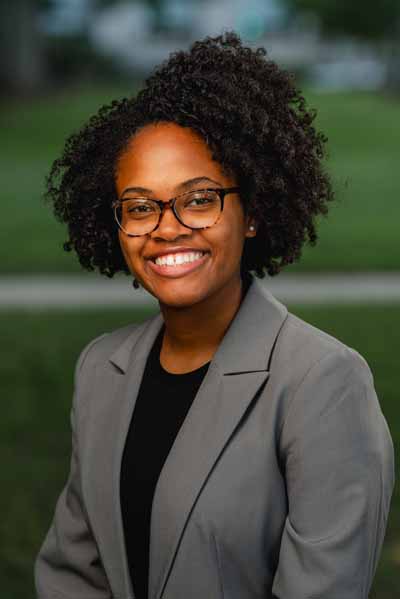
Taylor Vander
Howard University
Faculty Advisor: Prof. Haruko Wainwright
Research Supervisor: Alexander Kelly
Department: Nuclear Science and Engineering
Biography
Taylor Vander is a Computer Science major at Howard University, minoring in Mathematics
and Sociology, who researches trustworthy machine learning (ML) for high-stakes decisionmaking.
She previously developed geospatial ML models at the U.S. Naval Research Laboratory
with Dr. Taylor Lee and collaborated with Professor Phebe Vayanos at the University of Southern
California on robust ML methods for homelessness prioritization systems. This summer, as an
MSRP intern, she is working with Professor Haruko Wainwright on transferable ML approaches
for environmental monitoring. Driven by the belief that meaningful technical solutions begin by
listening to the communities they impact, Taylor served as Executive Student Director of Howard
University’s Alternative Spring Break, co-leading an initiative that sends over 1,200 students
annually to serve over 20 communities nationwide. Ultimately, she aims to build ML systems that
empower institutions to make better decisions while remaining grounded in the needs of the people
those decisions affect.
Transferability of Machine Learning Approaches for Groundwater Estimation
Across Legacy Contaminated Sites
Taylor Vander1, Alexander Kelly2 and Haruko Wainwright2,3
1Department of Electrical Engineering and Computer Science, Howard University
2Department of Civil and Environmental Engineering, Massachusetts Institute of Technology
3Department of Nuclear Science and Engineering, Massachusetts Institute of Technology
Groundwater is a critical freshwater resource, essential for public health and environmental
sustainability. Legacy contaminated sites associated with past nuclear production and energy
research require long-term groundwater monitoring because contaminants often persist in the
subsurface long after operations cease. Groundwater table elevation is particularly important to
monitor, as contaminant migration depends strongly on the hydraulic gradient. Machine learning
frameworks such as PyLEnM (Python for Long-term Environmental Monitoring) streamline
groundwater data analysis through an integrated data-to-machine-learning pipeline. However,
PyLEnM has only been developed and applied at the F-Area complex in South Carolina and
relies on site-specific spatial predictors, leaving its transferability to other hydrogeologic settings
uncertain. Here, we evaluate the transferability of the PyLEnM framework using groundwater
monitoring data from the legacy processing site at Shiprock, New Mexico. Groundwater elevation
is estimated using various regression models fit to terrain-derived predictors and evaluated
using leave-one-out cross-validation. Random Forest and Lasso regression emerged as the bestperforming
models, successfully generating high-resolution groundwater elevation maps. This
work demonstrates PyLEnM’s robustness and transferability for groundwater elevation estimation
and supports the development of scalable groundwater monitoring strategies for environmental
remediation.
