

Malik Savage
MIT Department:
Aeronautics and Astronautics
Faculty Mentor:
Daniel Varon
Research Supervisor:
Krishnma Rajesh Mehta, Vedant Rautela
Undergraduate Institution:
North Carolina A&T State University
Biography
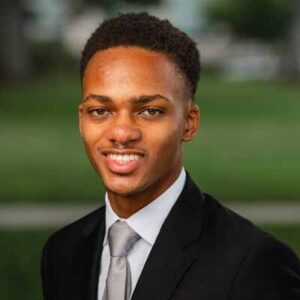
Malik Savage is an Electrical Engineering student at North Carolina Agricultural and Technical State University. His interest in engineering began in middle school through hands-on projects, including a functioning Iron Man helmet, and others involving electronics, programming, Raspberry Pis, and Arduinos, allowing his curiosity to become real creations. At North Carolina A&T, Malik participated in undergraduate research with Dr. Ioannis Raptis, working on visual models for a traffic system focused on congestion and drone integration. He also served as a team leader during the North Carolina A&T Hackathon, where his team won second place with Chevron for an engineering solution focused on early detection and prevention. Outside of school, Malik has worked with Interactive Sports, using technology to help make youth sports safer and more enjoyable. As an MSRP intern, Malik is excited to continue growing while exploring engineering applications in space and sensing technology.
Evaluating Methane Emission Recovery Through Simulations
Malik Savage1, Daniel Varon2, Vedant Rautela2, Krishma Mehta2
1Department of Electrical Engineering, North Carolina Agricultural and Technical State University
2Department of Aeronautics and Astronautics, Massachusetts Institute of Technology
Methane is a super pollutant in our atmosphere. Tracking methane emissions can help efforts to mitigate global warming. Methane inversion methods use satellite observations and ground estimates to estimate methane emissions. However, not knowing the true emissions makes it difficult to assess inversion accuracy. This project evaluated the ability of the Integrated Methane Inversion (IMI) to recover known methane emission changes by running simulations through an Observing System Simulation Experiment (OSSE). I developed the OSSE Configuration Application (OCA) to simplify OSSE setup and visualize the recovery analysis. OCA calculates and displays recovery percentages in grid cells on a map to help users understand the strengths and limitations of the inversion. Using OCA, experiments were completed over Dallas, Texas, and the Permian Basin using scale factors to determine how much IMI could recover in a simulated environment. Results showed IMI consistently improved methane emission estimates while identifying where IMI performs well and where it can be improved. By turning this process into an application, OCA provides the lab with a reusable tool for setting up future OSSE experiments and visualizing results. Future experiments will use this tool to test IMI performance and improve understanding of methane emission estimates.
