

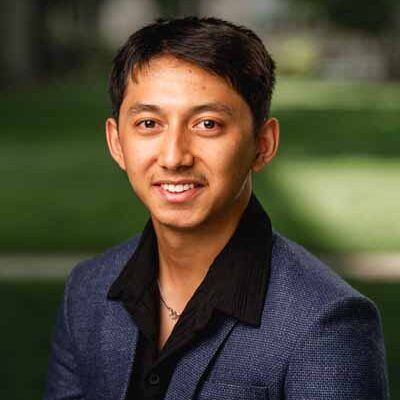
Kishor Baniya
MIT Department:
Earth, Atmospheric, and Planetary Sciences
Faculty Mentor:
Richard Teague
Research Supervisor:
Isabella Macias
Undergraduate Institution:
Caldwell University
Biography
Kishor Baniya is an undergraduate student at Caldwell University, double-majoring in Mathematics and Computer Science with a minor in Physics. His career goals are to obtain a Ph.D. in Astrophysics, acquire a research position at NASA-JPL, and pioneer cutting-edge research facilities back in his hometown, Nepal. As an NSF CI Compass fellow, Kishor has further interests in High Performance Computing. His research spans from investigating swirling protoplanetary disks to mysterious dark matter particles. With an emphasis on citizen science, he has also participated in the NASA L’SPACE Academy and UMD GRADMAP. At MIT, he works with Dr. Richard Teague and Isabella Macias at the Planet Formation Lab, developing robust methods for spectral analyses on JWST-MIRI observations. Beyond research, Kishor is devoted to songwriting and outreach, with experience at the Harvard CfA and service as the president of the astronomy club. Caldwell named him Student of the Year in 2025.
DeSICCATOR: Deconvolution of Spectral Interference via Component
Characterization and Analysis of Target Observational Residuals
Kishor Baniya1, 2, Richard Teague2, Isabella Macias2, and Lisa Wölfer2
1Department of Mathematics and Physics, Caldwell University
2Department of Earth, Atmospheric and Planetary Sciences, Massachusetts Institute of Technology
JWST/MIRI has opened a new window into the study of molecular composition in protoplanetary
disks, but dense water emission often obscures other planet-forming molecules such as HCN,
CO2, and C2H2. Current water subtraction methods rely on slow, case-by-case radiative transfer
fitting, limiting their scalability to large disk surveys. We investigate whether Principal Component
Analysis (PCA) can compress water emission models into a compact basis for rapid, generalizable
subtraction. Using the LTE slab package IRIS, we generate a library of synthetic water spectra
spanning disk-relevant temperatures and column densities. Through singular value decomposition,
we find that four components capture 99.95% of the library variance, confirming that water emission
is intrinsically low-dimensional. Applying this basis, we recover water models without per-object
fitting and find that the component scores show a strong correlation with the underlying excitation
conditions. We implement this framework in DeSICCATOR, an open-source Python package that
provides fast water subtraction and excitation diagnostics for current and future disk surveys.
