

Jay Chaudhari
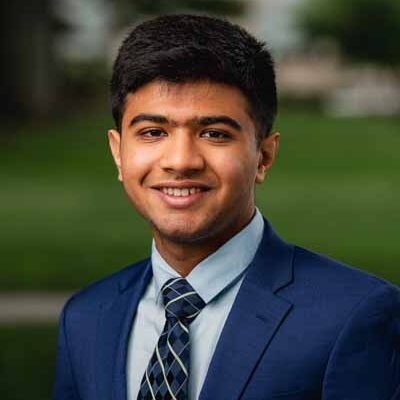
MIT Department:
Aeronautics and Astronautics
Faculty Mentor:
Paulo Lozano
Research Supervisor:
Dulani Withanage
Undergraduate Institution:
Georgia State University
Biography
Jay Chaudhari is a rising sophomore at Georgia State University Perimeter College, pursuing an Associate of Engineering. He plans to transfer to a four-year institution to major in Aerospace Engineering, where he can engage in advanced research and pursue a career in non-chemical propulsion, broadening his knowledge and enabling him to contribute to society in a meaningful way. Jay’s curiosity for research began when he joined the CORE research program at GSU, where he learned the fundamentals of research. Currently at MIT, he is simulating the deployment of the STEP-1 satellite from ISS, its staging process, and verifying S-band radio. This opportunity has led him to develop a deeper interest in pursuing a research career that helps humanity transition to a multi-planetary species, as current chemical propulsion systems are too heavy and slow for deep-space exploration. His exploratory interests also align with his adventurous hobbies, such as wilderness hiking and cycling.
Orbital Simulation of the Deployment and Staging of the Staged Electrospray
Pathfinder 1 Satellite
Jay Chaudhari1, Dulani Withanage2, and Paulo Lozano2
1Department of Computer Science and Engineering, Georgia State Perimeter College
2Department of Aeronautics and Astronautics, Massachusetts Institute of Technology
Electrospray propulsion uses an extractor grid to produce electric fields that extract and accelerate ions from a nonvolatile ionic liquid propellant, which generates thrust. The STEP-1 satellite is a project used to demonstrate electrospray propulsion in low Earth orbit. Our first objective for the simulation was to simulate the deployment of STEP-1 from the ISS and then determine the time required for the satellite to reach a safe distance from the ISS before we fire the thrusters, because premature firing could lead to re-contact with the ISS. After which, we generated a staging simulation to help determine the altitude and time for each event in the mission. This helped us determine the optimal time between mission sequences to successfully execute the mission. Free Flyer, an astrodynamics software, is used in the simulation. Moreover, we need the simulation data for the Trajectory Planning and Operations Officer because they will require an ephemeris file of each stage firing’s resulting trajectory, after which they can approve execution. The impact of this work will help carry out the mission without hazardous collisions with the ISS and will lead mission control in planning the STEP-1 mission sequence.
