

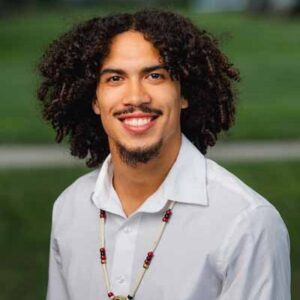
Jalen Ridgeway
MIT Department:
Mechanical Engineering
Faculty Mentor:
Peko Hosoi
Research Supervisor:
Michael Ewing
Undergraduate Institution:
University of Maryland, Eastern Shore
Biography
Jalen Ridgeway is a senior undergraduate student studying Exercise Science with a Clinical Concentration at the University of Maryland Eastern Shore. His current research interests are biomechanics, human movement, and AI-driven motion capture technologies for injury prevention, rehabilitation, and sports performance. As a Division I student-athlete, he is passionate about translating innovations in engineering and computer vision into practical tools that improve patient care and athletic performance. His previous research includes studies on exercise motivation in college students and polymer nanocomposites for aerospace applications. Beyond the laboratory, Jalen has worked with athletic trainers, shadowed a physical therapist, and organized community wellness initiatives promoting physical activity and diabetes prevention. Following graduation, he plans to pursue a combined physician-scientist career, advancing AI-assisted biomechanical assessment and rehabilitation while improving healthcare through translational research.
Markerless Motion Capture for Accessible Biomechanical Assessment
Jalen Ridgeway¹, Michael Ewing², Peko Hosoi²
¹Department of Kinesiology, University of Maryland Eastern Shore
²Department of Mechanical Engineering, Massachusetts Institute of Technology
Conventional biomechanical motion analysis often relies on marker-based systems that require specialized laboratories, expensive equipment, and extensive data processing. These limitations reduce access to motion analysis in clinical, athletic, and educational environments. This project investigated MediaPipe as a low cost markerless motion-capture system for analyzing human movement using a standard video camera. Participants completed functional movements, vertical jumps, and expressive poses while MediaPipe detected and tracked full-body landmarks in real time. The resulting skeletal models and movement data were evaluated based on tracking accuracy, processing speed, accessibility, and ease of use. MediaPipe demonstrated good visual accuracy when identifying major body landmarks and consistently represented participants’ movements through a digital skeleton. The system also processed video rapidly, allowing movement results to be displayed almost immediately after recording. These findings demonstrate that MediaPipe provides a fast, accessible approach to biomechanical assessment with potential applications in injury prevention, rehabilitation monitoring, human movement research, and interactive science education.
