

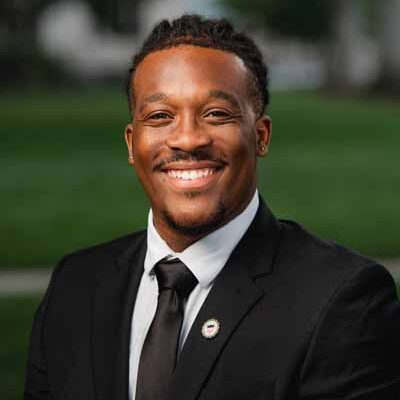
Ja Kobi Cockerham
MIT Department:
Physics
Faculty Mentor:
Christoph Paus
Research Supervisor:
David Walter, Luca Lavezzo
Undergraduate Institution:
Howard University
Biography
Ja Kobi is a rising sophomore studying physics and mathematics at the illustrious Howard University. Currently, he is conducting research at MIT’s Laboratory for Nuclear Science through the MIT Summer Research Program, where he works on the precise measurement of the strong coupling constant by reproducing the Z-boson in Drell-Yan events. His infatuation with physics began when he watched Gravity Falls as a child, a show that made the universe feel like something worth decoding. That early wonder sharpened into a long-term goal: pursuing graduate research in string theory and quantum field theory, chasing the deeper structures beneath the physics he studies today. Outside the lab, Ja Kobi volunteers with the YMCA, helps special needs children achieve their physical education goals, and studied abroad in Ghana. He spends his free time weightlifting, watching films, and reading Dostoyevsky, carrying the same discipline and curiosity into every room he enters.
Smoothing Statistical and Systematic Uncertainty Bands in MiNNLO Predictions
for Precision αs Extraction via Drell-Yan Z-boson Production
Ja Kobi D. Cockerham1, David Walter2, Luca Lavezzo2 and Christoph M.E. Paus2
1Department of Physics and Astronomy, Howard University
2Department of Physics, Massachusetts Institute of Technology
Precision measurements of fundamental particle interactions rely on comparing experimental data to theoretical predictions. However, finite Monte Carlo statistics used to estimate these predictions’ uncertainties can introduce noisy, non-physical fluctuations across measurement ranges. One vital input to such measurements, the strong coupling constant, is extracted from Drell-Yan events, yet current uncertainty bands derived from MiNNLO Monte Carlo predictions often carry bin-to-bin statistical noise, complicating their use in precise extractions. This project develops a procedure to characterize and smooth these statistical and systematic uncertainty bands across key kinematic variables in simulated collision data, using Python based statistical and histogram analysis tools to isolate genuine kinematic-dependent trends from random fluctuation. Initial application of this procedure to a subset of simulated events demonstrates its ability to distinguish structured trends from noise, particularly across the transverse momentum of the Z boson. Full application of this method across the complete dataset is expected to yield a quantified reduction in uncertainty band variance, directly improving the precision with which the coupling constant can be extracted. This approach offers a generalizable framework for incorporating smoothed uncertainty estimates into future precision measurements, with relevance to ongoing efforts across particle physics to refine fundamental constants with greater confidence.
