

Deon Fernando
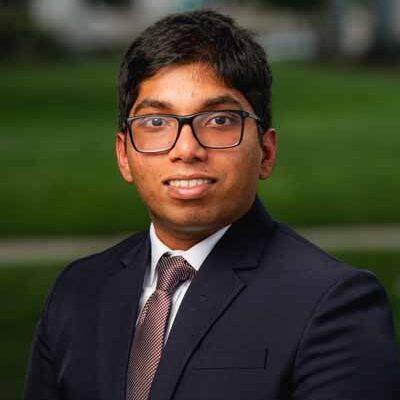
MIT Department:
Physics
Faculty Mentor:
Phillip Harris
Research Supervisor:
Christina Reissel
Undergraduate Institution:
University of Alabama
Biography
Deon Fernando is a rising junior majoring in Physics and Mathematics at The University of Alabama. In Dr. Jeremy Bailin’s galaxy formation group, he recognized a major computational bottleneck in circumgalactic medium analysis and built a denoising autoencoder to improve MCMC analysis speed, conditioning its latent space on the underlying physics. At the Alabama Water Institute, he developed a framework to detect when hydrology surrogate models are operating outside their learned experience, work he presented at the 2025 American Geophysical Union conference and is now developing into a publication. This summer, as an MSRP intern with Dr. Phillip Harris and Dr. Christina Reissel, Deon is building a contrastive Gaussian embedding framework that uses negative log-likelihood in latent space for statistical inference and anomaly detection in gravitational waves. He aspires to pursue a PhD in computational physics, focusing on building tools that help discoveries in physics move faster and scale further.
Witness-Augmented Contrastive Learning for Gravitational Wave
Transient Classification
Deon Fernando1,2, Christina Reissel2 and Philip Harris2
1Department of Physics and Astronomy, The University of Alabama
2Department of Physics, Massachusetts Institute of Technology
Gravitational waves have opened a new window into our understanding of the universe, and their detection relies on advanced laser interferometry to measure minute ripples in spacetime. However, these signals are frequently masked by environmental and instrumental transients, known as “glitches,” which complicate signal identification. Current gravitational-wave astronomy pipelines mitigate this noise by analyzing over 200,000 auxiliary detector channels; yet, this rich diagnostic information is traditionally restricted to post-detection veto analysis. While modern neural networks have revolutionized rapid signal classification, they typically rely on primary strain data alone, leaving this extensive auxiliary metadata unused during the critical real-time detection window. We bridge this gap by introducing a multi-modal joint embedding framework with dual-encoder architecture that integrates auxiliary witness channels directly into the classification process. Our architecture utilizes state-space models (Mamba) regularized by a Supervised Sketched Isotopic Gaussian Regularization (SuperSIGReg) framework. This method enforces a geometrically structured embedding space, enabling robust out-of-distribution detection and statistical inference. We demonstrate that incorporating auxiliary channels improves the network’s ability to distinguish true gravitational-wave signals from noise. We expect to integrate this framework into existing online parameter estimation and anomaly detection pipelines to provide a robust foundation for real-time gravitational-wave inference.
