

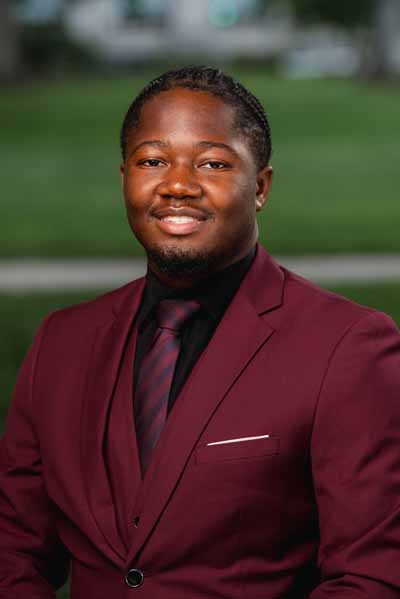
D’Andre Washington
Claflin University
Faculty Advisor: Prof. Danielle Wood
Research Supervisor: Alissa Chavalithumrong
Department: Electrical Engineering and Computer Science
Biography
D’Andre Washington is an undergraduate pursuing his BS in Computer Engineering at
Claflin University’s School of Natural Sciences and Mathematics. Hailing from the historical
city of Charleston, South Carolina. He works in the Space Enabled lab under Professor Daniell
Wood at MIT, where his research focuses on human-robot interactions in space. He is a
problem-solving thinker who possesses a growth mindset and is deeply interested in exploring
the frontiers of knowledge. Their strength lies in diving beneath the surface to ask probing
questions to solve the right problems. Consuming fantasy themes in media is what sparked
his passion for computer engineering. D’Andre has many interests, including technology,
biology, and psychology. He would like to explore the intersection of these areas by leveraging
technology to create solutions and solve problems in those fields. After undergrad, he will
attend graduate school to obtain his master’s and or PhD.
Human-Robot Interaction with Robots in Microgravity
D’Andre Washington1, Alissa Chavalithumrong2, Dr. Scott Dorrington2, and
Dr. Danielle Wood2
1Department of Mathematical and Computer Science, Claflin University
2Program of Media Arts and Sciences, Massachusetts Institute of Technology\
Robots are being utilized in space applications for various purposes, including conducting
research, capturing images, and maintaining spacecraft. The use of robots in space is shifting
towards collaborative-work alongside humans. Advancing human-robot collaboration in space
requires interfaces that improve task efficiency and reduce mental workload, which prior
studies show enhances trust and interaction quality. This research explores hand gestures and
visual interfaces as communication methods for human-robot interaction (HRI). On the human
side, the goal is to determine which hand gestures users find most intuitive, based on user data.
From the robotic side, lighted signals and screen displays are used to communicate intent.
This study uses Astrobee, NASA’s free-flying autonomous robot aboard the International
Space Station, as a candidate HRI platform, along with analogous platforms like drones. To
evaluate the effectiveness of visual communication, mock images and icons were designed for
Astrobee, and animations were evaluated to determine which convey the most meaning and
align with human interaction design principles. The goal is to identify hand gestures that are
most effective for controlling a robot in space, and also to identify animations that convey clear
meaning to users.
