

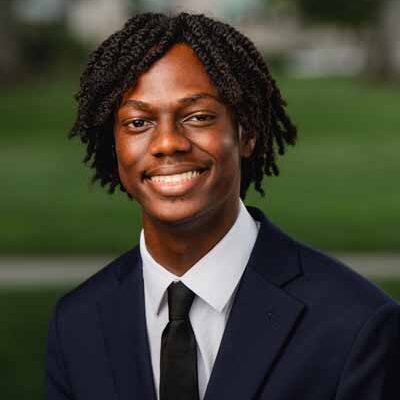
Amir Bland
MIT Department:
Electrical Engineering and Computer Science
Faculty Mentor:
Samantha Coday
Research Supervisor:
Jonah Rawley
Undergraduate Institution:
North Carolina A&T State University
Biography
Amir Bland is a rising sophomore at North Carolina A&T State University pursuing a career in engineering with a focus on sustainability. He is passionate about improving energy systems, advancing biofuels, and developing sustainable infrastructure that benefits urban communities. Currently, Amir conducts research in the Research Laboratory of Electronics (RLE) under the mentorship of Samantha Coday, where he helps automate the analysis of power electronics to support the development of more efficient power converter designs. At North Carolina A&T, Amir is an active member of the National Society of Black Engineers (NSBE), the Future of STEM Scholars Initiative (FOSSI), and the Honors College. Through his academic, research, and leadership experiences, he is committed to using engineering to address complex energy challenges and create lasting, sustainable solutions that positively impact his community.
Automation of Power Electronics Analysis
Amir Bland¹, Jonah Rawley², Samantha Coday³
1Department of Mechanical Engineering, North Carolina Agricultural and Technical State University
²Department of Electrical Engineering and Computer Science, Massachusetts Institute of Technology
A Flying Capacitor Multilevel Converter (FCML) uses capacitors to reduce inductor size and lower the voltage-blocking requirements of power switches. To achieve these benefits, the energy levels of the capacitors must remain balanced. Although this balancing behavior can be modeled, validating these models requires extensive testing across a range of converter design parameters. Currently, this validation process requires researchers to manually interface with a microcontroller to modify variables and record experimental data, making each parameter sweep time-consuming, typically taking between 30 minutes and one hour. To address this limitation, an automated graphical user interface (GUI) was developed to perform converter sweep analyses programmatically. Using only a JSON configuration file, researchers can define and execute customized parameter sweeps with minimal user intervention. The program was validated through multiple experimental tests, with results matching those obtained using the previous manual process. By automating data collection and parameter adjustment, the system reduces analysis time from nearly an hour to only a few minutes while eliminating opportunities for human error. Although the software was developed for FCML analysis, it was intentionally designed with flexibility in mind, allowing researchers to adapt it for automated testing of other power electronic systems.
