

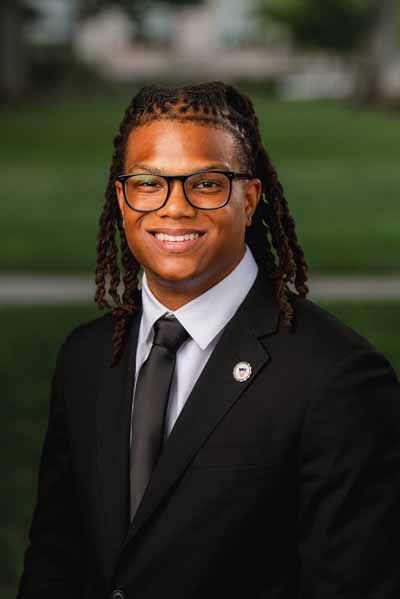
Aidan Talley
Howard University
Faculty Advisor: Prof. TJ Wallin
Research Supervisors: Hunter Whaples
Department: Materials Science and Engineering
Biography
Aidan Talley is a rising sophomore Mechanical Engineering major and Mathematics
minor at Howard University, where he maintains a 4.0 GPA. As a member of the Karsh
STEM Scholars Program, Aidan is dedicated to pursuing a PhD. His research experience
includes modeling and testing aerodynamic structures at Howard’s Applied Fluids & Thermal
Engineering Research Laboratory. Currently, as a 2026 MIT Summer Research Program
(MSRP) intern in the Wallin Lab, he explores visible-light photoinitiators for open-source
tomographic additive manufacturing. Driven by a passion for interdisciplinary innovation,
Aidan combines sharp analytical thinking with hands-on collaboration to solve complex
engineering challenges. Beyond academics, he is actively involved in the organization Men of
George Washington Carver Incorporated, volunteering to build a supportive and empowering
community for men on campus. His unique blend of technical expertise and community
leadership makes him a strong contributor to both research teams and campus organizations.
Visible Light Photoinitiators for Open-Source Tomographic VAM
Aidan Talley1, Hunter Whaples2, Dr. T.J. Wallin2
1Department of Mechanical Engineering, Howard University
2Department of Materials Science and Engineering, Massachusetts Institute of Technology
Volumetric additive manufacturing (VAM) is a rapid, layer-free 3D printing process
that produces parts by projecting tomographic photopatterns into a rotating volume
of photopolymer resin. These overlapping projections generate a three-dimensional
photodose distribution that spatially controls the local initiation rate to selectively solidify
a desired geometry. While conventional VAM relies on ultraviolet (UV) excision of Type I
photoinitiators like TPO and BAPO, OpenCAL – a recent open-source VAM architecture –
utilizes visible wavelengths. Both approaches, however, are incompatible with commodity
UV printing resins. High photoinitiator loading causes excessive UV attention that prevents
deep light penetration required for VAM. These same initiators exhibit negligible reactivity in
the visible regime. To expand the accessible material suited for visible-light VAM, this work
investigates the incorporation of triethanolamine (TEOA) as a sensitizer in both commercial
resins and a laboratory-formulated diurethane dimethacrylate (DUDMA) system. Under 440
nm irradiation, TPO and BAPO can reach an excited electron state but do not readily cleave.
TEOA can engage these excited states via electron transfer to generate α-amino alkyl radicals
that efficiently drive polymerization without significantly increasing optical attenuation. This
enables high monomer conversion under blue-light irradiation while preserving the bulk
optical transparency required for volumetric dose construction
