

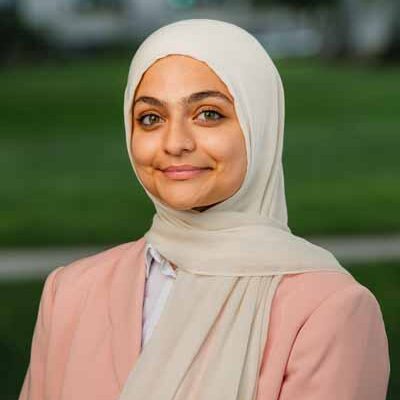
Aamina Al-Yahia
MIT Department:
Political Science
Faculty Mentor:
Mai Hassan
Research Supervisor:
Richard Nielson
Undergraduate Institution:
University of Florida
Biography
Aamina Al-Yahia is in her last year at the University of Florida, studying Anthropology and Philosophy, Politics, and Economics. She is interested in the law as a means of establishing transitional justice. Through her studies, Aamina has discovered a passion for political theory and contrasting that with people’s lived experiences. She hopes to translate this into a career in law and governance by pursuing a J.D. To gain experience in the field, she has interned in the Turkish Senate and is currently a Political Science Research Intern at MIT. Outside her studies and work, she enjoys reading, calligraphy, visiting art museums, traveling, and spending time in Florida’s beautiful outdoors. She enjoys entering new spaces and learning from others’ perspectives, allowing her to learn from those around her and foster understanding in new spaces.
Trust, Transition, and Participation: Civic Engagement Among Syrian University
Students in Post-Assad Syria
Aamina Al-Yahia1, Dr. Mai Hassan2
1Department of Anthropology, University of Florida
2Department of Political Science, Massachusetts Institute of Technology
Following the collapse of the Assad regime, Syria faces the challenge of rebuilding political
institutions capable of fostering legitimacy, accountability, and public participation. While
much attention has focused on elite decision-making, the attitudes of young Syrians who will
play a central role in shaping the country’s future remain understudied. This study investigates
how Syrian university students perceive civic and political engagement during the country’s
post-authoritarian transition and examines the factors influencing their willingness to
participate in rebuilding public life. Drawing on theories of civic participation and democratic
transition, the project explores how trust in emerging institutions, perceptions of political
efficacy, and conceptions of citizenship shape students’ engagement. Using a mixed-methods
design, the study combines surveys with semi-structured interviews conducted with university
students across Syria to capture both broad trends and individual experiences. By centering
the perspectives of Syrian youth, this research contributes to scholarship on post-conflict
reconstruction, state-building, and democratization while providing insights into the role of the
next generation in establishing durable and participatory political institutions.
