

Diego Terrones Floresgomez
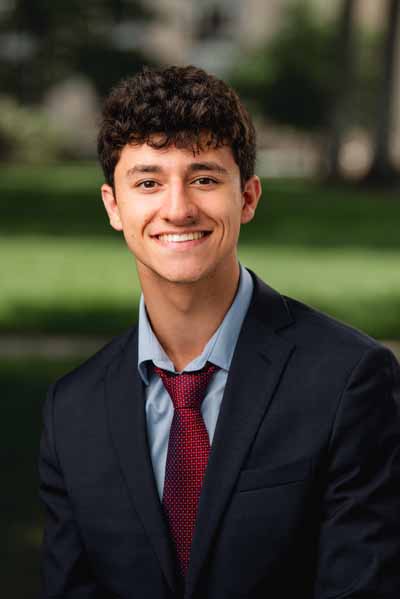
Rice University
Faculty Advisor: Prof. Pablo Jarillo-Herrero
Research Supervisor: Xueqiao Wang
Department: Physics
Biography
Terrones Floresgomez is a rising junior at Rice University pursuing a double
major in physics and mathematics. His interests lie in condensed matter physics, quantum materials,
and materials science, with a particular fascination for how atomic-scale changes give
rise to remarkable physical phenomena. He has conducted computational research on novel
materials with the Dabo Group at Carnegie Mellon University, where he presented his work
through a poster and a co-authored publication. At the National University of Singapore, he
used computational models to analyze graphene oxide membranes at IFM under Sir Konstantin
Novoselov. At Rice University, in collaboration with Penn State University, he received awards
for oral and poster presentations on surface-enhanced Raman spectroscopy of vanadium-doped
tungsten disulfide. He also co-authored a review paper on the evolution and state of the art
of diamond growth and applications. He hopes to pursue a Ph.D. and continue exploring the
atomic realm.
Sliding Ferroelectricity in Twisted Bilayer Boron Nitride
Diego Terrones1,2, Xueqiao Wang2 and Pablo Jarillo-Herrero2
1Department of Physics, Rice University
2Department of Physics, Massachusetts Institute of Technology
Ferroelectric field-effect transistors (FeFETs) are promising candidates for non-volatile
memory devices due to their ability to retain information through remanent ferroelectric
polarization, enabling low-power, high-speed, and non-volatile data storage. FeFETs
face issues such as endurance degradation and thickness scaling which coupled with the
shrinking of device dimensions motivates the search for novel ultrathin FeFETs. Bilayer
boron nitride (BN) has shown its ultrafast high-endurance ferroelectric capabilities through a
sliding mechanism where the atomic layers slide against each other reversing the structure’s
polarization. This reversal is induced via a displacement field which favors AB or BA stacking.
Introducing a twist angle of 0.6° forms a moiré superlattice consisting of periodic AB, BA,
and AA stacking domains, giving rise to more complex switching behavior than in parallel
BN. In this study, we compare conventional one-shot switching with pulse-train switching by
systematically varying pulse height, pulse duration, burst count, and duty cycle to investigate
how different pulse schemes influence polarization reversal. These measurements provide
insight into the underlying domain-wall dynamics and switching thresholds governing moiré
ferroelectric switching. Our results further indicate the presence of intermediate polarization
states that are absent in parallel BN, providing new insight into the stochastic nature of moiré
ferroelectric switching.
