

Asher Ferreira
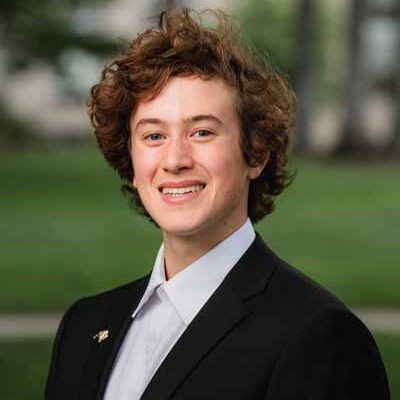
MIT Department:
Chemistry
Faculty Mentor:
Cathy Drennan
Research Supervisor:
Zhuangyu Zhao
Undergraduate Institution:
University of Colorado, Boulder
Biography
Asher has been passionate about inventing cures for diseases since being diagnosed with Type 1 Diabetes at 9 years old. He joined the Luger Lab during his freshman year. Now heading into his senior year at CU Boulder, he has applied his experience with a myriad of structural biology and biochemistry techniques to innovative drug development. He worked full-time for two summers at MIT in the Drennan Lab, where he proposed a new antibiotic target, invented assays to find inhibitors, and designed new proteins. He hopes to develop FDA-approved drugs over the course of his career and is applying to chemical biology PhD programs in Fall 2026. Asher is also passionate about empowering the next generation of scientists. In addition to leading middle school science education outreach, he started SCORSU, a national research study investigating how a diverse sample of STEM undergraduates has been differentially affected by federal cuts to scientific funding.
iScreen Cone: A Tasty New Method for Finding Antibiotics
Asher Ferreira1, Zhuangyu Zhao2 and Catherine Drennan2
1Department of Biochemistry, University of Colorado Boulder
2 Department of Chemistry, Massachusetts Institute of Technology
Resistance to antibiotics is rising globally largely due to the widespread use of broad-spectrum antibiotics and lack of narrow-spectrum alternatives. The scarcity of new enzymatic antibiotic targets plays a significant role in the fact that only a couple of new antibiotics reach the market globally every year. An attractive new target is the enzyme ribonucleotide reductase (RNR) because of its critical role in DNA synthesis and enormous diversity across life. A molecule that can selectively inhibit the RNR of specific bacteria would be a potent narrow-spectrum antibiotic. However, current assays which measure the inhibition of RNRs are laborious and low throughput. In a departure from established RNR activity assays, we are developing methods which exploit their unique naturally occurring inhibition mechanism. Many RNRs possess subunits called “cone domains” which bind to each other to inhibit the enzyme. By detecting this binding event instead of enzymatic activity directly, we are developing high-throughput screens for inhibitors using the cone domains (iscreen cone assays) to greatly accelerate the discovery of narrow-spectrum antibiotic candidates and improve our understanding of RNR inhibition mechanisms.
