

Avery Banks
MIT Department:
Aeronautics and Astronautics
Faculty Mentor:
Brian Wardle
Research Supervisor:
Armando Neto, Marianna Rogers
Undergraduate Institution:
Washington University in St. Louis
Biography
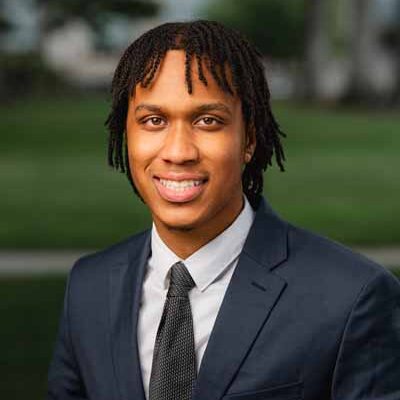
Avery Banks is a rising senior at Washington University in St. Louis studying Mechanical Engineering, with research interests in aerospace materials and guidance, navigation, and control systems. In summer 2024, he worked at the CHROME Aerospace Lab, where he developed an autonomous robotic lab tour guide programmed for obstacle avoidance, voice recognition, and interactive engagement. Last summer, he conducted research in MIT’s necstlab, manufacturing aligned carbon nanotube nanocomposites for thermal protection systems, including ablative heat shields for spacecraft. This summer, Avery is returning to necstlab through MSRP to develop ultrathin Tailored Antisymmetric Composite laminates, which use controlled laminate asymmetry to reduce ply count while enabling extension–bending and bend–twist couplings for improved mechanical performance. Beyond research, Avery runs a tutoring company for students in underserved communities, serves as vice president of WashU’s NSBE chapter, and conducts acoustofluidic research at WashU. He is excited to begin the graduate school application process this fall.
Approaching the Thickness Limit of Tailored Antisymmetric Composites via the Bulk
Nanocomposite Laminating Process
Avery Banks1, Armando Neto2, Marianna Rogers2, and Brian Wardle2,3
1Department of Mechanical Engineering, Washington University in St. Louis
2Department of Aeronautics and Astronautics, Massachusetts Institute of Technology
3Department of Mechanical Engineering, Massachusetts Institute of Technology
The aerospace industry is increasingly driven toward thinner, lighter composite structures, yet
traditional balanced-symmetric laminates often meet stiffness and damage-tolerance requirements
by stacking multiple sub-laminates, increasing thickness, mass, and manufacturing complexity.
Tailored Antisymmetric Composites (TACs) offer an alternative architecture by using controlled
asymmetry to achieve mechanical performance with reduced ply count, extension–bending coupling,
and bend–twist coupling. However, the lower thickness limit of TAC architectures remains poorly
understood, particularly for nanostructured systems where processing, handling, and polymer infiltration become challenging. Here, we fabricate ultrathin TAC laminates using the bulk nanocomposite laminating (BNL) process, in which carbon nanotube (CNT) forests are mechanically knocked down, densified, and infused with an EPON 862 epoxy matrix to form horizontally aligned CNT/EPON nanocomposites. Both hard and soft TAC configurations are manufactured to examine how stiffness regime influences mechanical response at ultrathin dimensions. The laminates will be characterized through thickness measurements, microscopy, tensile testing, and bend–twist testing to evaluate structural quality, mechanical properties, warping, and predicted deformation behavior. This work will assess the feasibility of BNL processing for ultrathin TAC architectures and establish a foundation for nanostructured asymmetric composites in lightweight, thickness-limited aerospace structures.
