

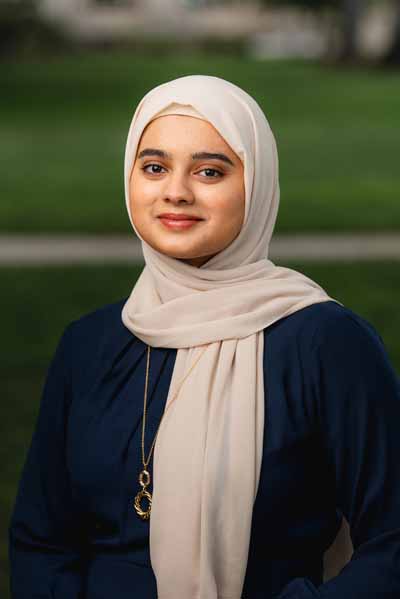
Zoya Ahmed
Xavier University of Louisiana
Faculty Advisor: Prof. Alex Shalek
Research Supervisor: Benoit Desboilles
Department: Chemistry
Biography
Zoya Ahmed is a Senior at Xavier University of Louisiana, studying Public Health Sciences
with a minor in biology, chemistry, and history, planning to pursue her PhD in Women’s Health. As a
New Orleans native, connecting with her community and interning at the Ochsner-Xavier Institute for
Health Equity Research (OXIHER) are what defined her passion for managing insulin resistance-related
diseases through traditional and holistic care. She strengthened her passion for bridging the gap between
clinical medicine and community-level public health interventions while working on the STRIVE study
with Tulane’s SPHTM. This summer, Zoya is working with Dr. Benoit Desbiolles in the Shalek Lab,
focusing on fabricating freestanding micro-nanodevices to transport through biological tissues. In the
future, Zoya aims to investigate how epigenetics, psychosocial stressors, and dietary inflammatory
markers contribute to metabolic dysfunction within high-risk populations and how these factors may
lead to disproportionate health diagnoses and outcomes.
Free Standing Micro-Nano Devices for Studying 3D Tissue
Zoya Ahmed1, Benoit Desbiolles2,3,4,5, DK Alakwe2,3,4,5, and Alex Shalek2,3,4,5
1Department of Public Health Sciences, Xavier University of Louisiana
2Department of Chemistry, Massachusetts Institute of Technology
3Broad Institute of MIT and Harvard University
4Institute of Medical Engineering and Science, Massachusetts Institute of Technology
5Ragon Institute of Massachusetts General Brigham, MIT, and Harvard University
Studying cells in their native three-dimensional (3D) environment is essential for understanding
cellular function. Cells rely on complex interactions with neighboring cells and the extracellular
matrix to regulate fundamental biological processes, behaviors that are heavily shaped by the
mechanical and chemical cues of their native 3D environment. However, most existing technologies
are limited to two-dimensional (2D) models, highlighting the need for tools that enable cellular
interrogation within intact 3D tissues. To address this need, we developed freestanding micro/
nanodevices capable of penetrating and distributing throughout 3D tissue to wirelessly probe and
modulate cellular characteristics in their native microenvironment need to be developed. This project
evaluated centrifugation and electrophoresis as actuation modalities for delivering freestanding
micro/nanodevices into tissue. First, we developed a theoretical model to estimate the forces
generated by each modality and compare them with the force required to penetrate the extracellular
matrix. Next, we developed a scalable micro/nanofabrication process to manufacture the devices.
Finally, we characterized device distribution within agarose phantom tissue using optical microscopy
to validate our theoretical predictions. Identifying the optimal delivery modality will enable device
distribution throughout intact 3D tissues, advancing the study of cellular characteristics within their
native architecture.
